Love or treat (yoself)?

There are several Oprah-esque sayings that are floating around — 


“You have to take care of number one before you can take care of anyone else!”

“Treat yoself!”

“If you don’t love yourself you can’t love anyone else.”
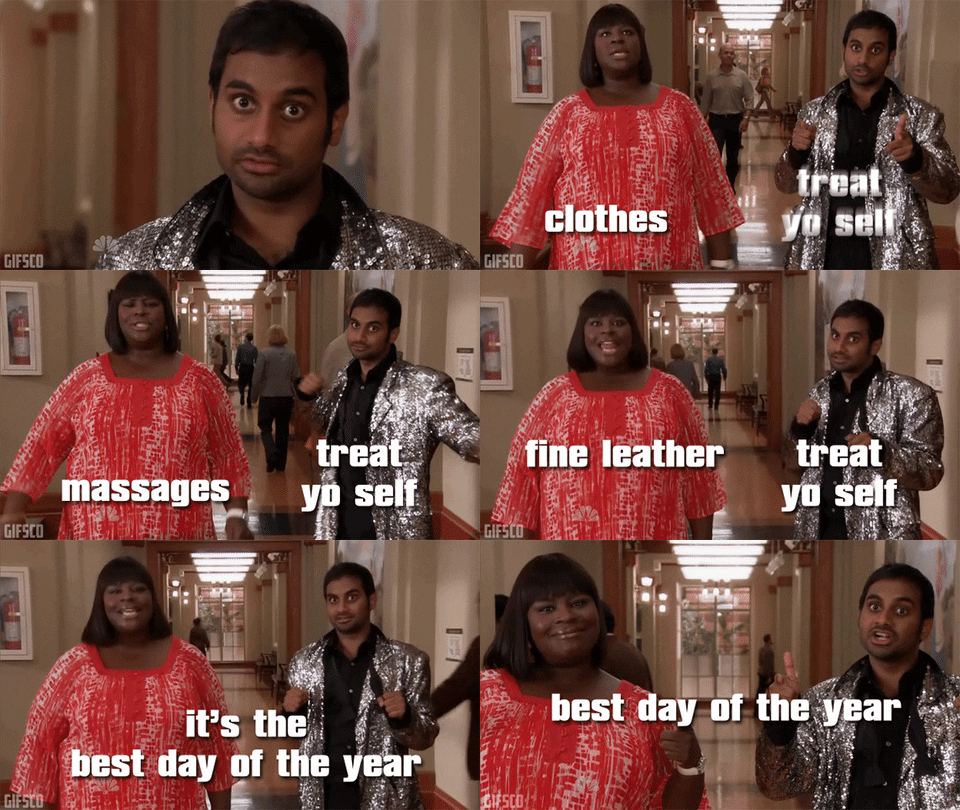
Treat Yo Self GIF - Find & Share on GIPHY
We all know this gif was 100% obligatory

–For the sake of conciseness, I’m going to use Treat Yoself to encapsulate all of these self-affirming ideologies–

Part of me thinks this inspirational folk wisdomry in Treat Yoself is a bucket of rat poo. My main problem with the self-love bonanza is related to the context in which these statements are uttered, more than the actual statements themselves. Usually they are said to encourage people to be selfish or indulgent. I can only speak for myself, but I do not know anyone who is so caught up in being selfless and sacrificial that they somehow neglect themselves.* I would argue that most people need to hear “Sure take care of yourself, but why doncha try caring for others,” or “Treat (people less fortunate than) yoself!” or “Try to love… or at least consider the feelings and wants of… someone besides yourself.”

My second sub-issue with the Treat Yoself mentality is that treating yourself in terms of indulgence isn’t really a treat for you in the long run. Most people want to have nice bodies that function well, but if they continuously “treat themselves” with McDonald’s fries and Starbucks frapaccinos and refuse to move their body in any way that gives it strength, speed, or flexibility, their bodies will soon become… something that doesn’t spark joy. Most people want to have the treat of traveling the world, but if they continuously live above their means and treat themselves with expensive food, entertainment, cars, etc. in the domestic realm, poofity goes the treat of travel.

My third and final irritation with Treat Yoself is a little more specific to Christians, although I don’t think you necessarily have to ascribe to the apostle’s creed to get something out of this. Jesus did not prance about ancient Israel proclaiming a new covenant of self-love. If anything, the level of self-sacrifice he and many of his disciples demonstrated is plum terrifying. Remember Luke 9- “foxes have holes and the birds of the air have nests, but the Son of Man [Jesus] has nowhere to lay His head.” Or Luke 17 “Whoever seeks to preserve his life will lose it, but whoever loses his life will keep it.” Or how about the sobering Mathew 10 warning “Beware of men, for they will deliver you over to courts and flog you in their synagogues, and you will be dragged before governors and kings for my sake, to bear witness before them…” And these are only what Jesus said, but when you consider what he did…! I have serious doubts that Jesus was contemplating a bubble bath and wine in the Garden of Gethsemane, and there is nothing less Treat Yoself in all of history than a man dying for people who hated and misunderstood him.  

So, my beef with Treat Yoself is that 1) it doesn’t seem necessary, given the deep self-indulgence and entitlement that most of us already have and 2) temporary treats often undermine long-term treats (which may or may not be more wholesome in nature because involve dreaming, scheming, and the real longings of your heart–not simply the capricious whims of your body and immediate longings) and 3) it doesn’t seem particularly “on message” with people who are presumably interested in modeling the radically sacrificial nature of Jesus.  

Yet! Part of me sees some truth glimmering through all that rat poo.

The major reason I haven’t completely dismissed Treat Yoself is largely related to mental health and margin**. Let’s take even a light example – being stressed out. When I am stressed, I don’t “see” other people or take particular interest in their needs. I am thinking of whatever is stressing me out, and how to make myself feel better during the stressful time. That means I refuse to think about hard or important questions, and dissipation becomes my goal. I avoid people who are also stressed out because their stresses suck my mind further into a cesspool of anxiety. How can I be a rock for someone when I’m crumbling? Instead of having interesting and joyful conversations with my friends and family, I hijack quality time by dumping my stress on whichever poor soul was unfortunate enough to spend time with me.

Thus, if spending time in nature, enjoying beautiful and lovely things, getting my toes painted happy colors, and reading lighthearted fiction can help reduce my stress to the point I can stop my navel-gazing long enough to look at other people… is that an indirect way to love others? I think it could be.

Where does that leave us, then? I think the key might be to Love Yoself, not Treat Yoself. Treating indicates indulgence. Love indicates more wholistic well-being. Think about a parent loving their child. Spoiling the child isn’t really love – spoiling a child is more indicative that the parent is too lazy to properly discipline, or too insecure to handle their child getting angry at them for rules that are meant to protect them. I think being an adult is learning how to parent yourself properly – love yourself, not spoil yourself. Be willing to deny your childish impulses so that you can be the person you actually want to be — and who the people around you need you to be.   

The world needs adults, not petulant children. So Love Yoself 😊

— EDITORIAL NOTES —

*I do know some martyrs who make a big to-do of how they are ruining their lives for the sake of others… I do not consider that actual selflessness. It’s a twisted form of pride.

 **Double points for sneaking in a Christian buzz word! BAM!  

 **Double points for sneaking in a Christian buzz word! BAM!

I refuse to love you exactly the way you are

“Why can’t you love me for who I am?”

You’ve heard some variation of this question, whether from someone you actually know or while watching some dramatic interaction on the telly. It’s usually a question that doesn’t really want a real answer. It’s typically asked to shame the other person more than anything else. The implicit assumption is that real love wouldn’t want or ask for someone to change anything about themselves.

Toy Story 4 Disney GIF - Find & Share on GIPHY

I’m not sure if that’s true. Here is why.

  • You will change, guaranteed
    • As the renowned Timothy Keller points out in the Meaning of Marriage, you should never be so enamored by the person your partner is right now that you would be devastated if they ever change. Why? Because they definitely will. Experience changes us. Time changes us. Relationships change us! It’s inevitable.
  • You should want to change
    • Everyone has varying degrees of ickiness in themselves. Let’s take for example, me. I like myself. I think I’m pretty legit. Yet, I know I have flaws. My acknowledgment of my flaws doesn’t lead me to severe self-hatred, but I do want to tame or obliterate them depending on their severity.
  • People who love you should want you to change
    • My friends and family who support me in moving forward and becoming a better version of myself are good for me. I am thankful for them. Who wants a friend spitting out their tobacco and snarling “You think you’re better than us?” and resenting your growth? Not I, said the fly.  
  • You cannot change everything about yourself
    • An important distinction in this entire Chat du Change is to strive for – and hope for, in others – changes that are actually possible and/or likely. I may not like that I can be overly emotional sometimes, but barring a drastic personality change I’m not likely to become a stoic anytime soon. BUT, I can still hope to change how much I am controlled by my wavepool of feels.  
The Exorcist Look Doc I Really Dont Understand How Her Whole Personality Could Change GIF - Find & Share on GIPHY

All that being said, I also know it’s foolish to enter into a relationship (romantic or otherwise) wanting and expecting someone to change in the exact way that I want — especially if that person shows no signs of wanting that change themselves. Or, even if they appreciate the idealized version of themselves, they are making little to no progress getting there.

[IMPORTANT ADDENDUM 04/12/19: I have had a few fellas that became very smitten with a version of Cgallo that wasn’t real. It’s a little delicate, but maybe the best scenario is to have clear double vision — the ability to see and love who someone is now, but also the ability to see, love, and support a future version of themselves that they see and want to become too. I think?! I ain’t no relationship therapist! ]

Altogether, I think what might be important is surrounding yourself with people who are excited for and encourage you to be the person you could and will probably turn into. Anddddd can put up with your flaws in the meantime. God bless ‘em!

Thank U GIF by Mauro Gatti - Find & Share on GIPHY

A song for the barely-sinner

I grew up in church. My family wasn’t just half-bootied Sunday morning service people, either. We did Sunday school AND Sunday night AND Wednesday night church, too ! #holy I’m glad we did, for many reasons. Most of my best friends growing up were from church. We knew everyone. People actually noticed when we went on vacation. There were several members – especially some older couples – who I know genuinely loved me and my family. Why else would Mr. Moreland always offer me a piece of red hot gum with a twinkle in his eye, or Mrs. Daugherty give me the bestest warm squishy hugs?

There were a few downsides to being raised in a fairly idyllic environment surrounded by amazing people. One of them was having a really hard time recognizing the weight of God’s grace. I remember having a true crisis when I was about 8, confessing to my mom with sincere guilt, “But I really can’t think of anyway that I’ve sinned!”*

Even now, having been through some shtuffs that definitelyyyy involved some less-than-spiritual-perfection, I have a really hard time not falling into a weird sort of good-girl legalism. This shows up the most when something I want is delayed or denied, while someone I have unconcsciously deigned more sinful than me** does get that thing. Absolutely infuriates me. I have to read Prodigal God by Tim Keller to get me to wind down. #thankyoutim 

This entire ramble was inspired by this song I heard today, which is so entirely perfect for my type of barely-sinner*** heart that I must share.. I MUST !! Sometimes a gallo needs art – in this specific case, musicals – to express for her what she didn’t even know she wanted to express.

(Strongly recommend just listening)

Not in me by Eric Schumacher and David L. Ward

No list of sins I have not done,
No list of virtues I pursue,
No list of those I am not like
Can earn myself a place with You.
O God, be merciful to me–
I am a sinner through and through!
My only hope of righteousness
Is not in me, but only You.
 
No humble dress, no fervent prayer,
No lifted hands, no tearful song,
No recitation of the truth
Can justify a single wrong.
My righteousness is Jesus’ life,
My debt was paid by Jesus’ death,
My weary load was borne by Him
And He alone can give me rest.
 
No separation from the world,
No work I do, no gift I give
Can cleanse my conscience, cleanse my hands;
I cannot cause my soul to live.
But Jesus died and rose again–
The power of death is overthrown!
My God is merciful to me
And merciful in Christ alone.
 
My righteousness is Jesus’ life,
My debt was paid by Jesus’ death,
My weary load was borne by Him
And He alone can give me rest.

— EDITORIAL NOTES —

* THAT is no longer a problem…

**it’s okay if you lowkey or highkey hate me for this post. Keeping it real y’all

*** I say this tongue and cheekily!

What to (and not!) learn from your past relationships

The last time I had a really bad breakup, people kept telling me “It wasn’t a waste as long you learned something from it.” I say this with full love in my heart for these people, but a week after a breakup is not a good time to hear this. I would think with great bitterness and characteristic drama, “Oh, so to learn that I’m unlovable, all I have to do is put myself through a heart-pulverizing breakup – fantastic.”

As time dribbles on, however, one does gain some perspective. Our minds sort of force us to learn something. Sometimes the learnt info is useful and helps us become a better person / partner… *BUT* I have learned that you can learn the wrong things and draw the wrong conclusions from your own experiences. 

What not to Learn

I think one of the most natural things to learn from a past relationship is signs and cues that whoever you’re dating is going to hurt you. You learned that his long delays between texts meant he was losing interest, or her need for “alone time” was really her need for cheaty-cheat times. It is all too easy to transfer that knowledge – of what that speific action for that specific person meant for your past relationship in that specific moment in time – to a new relationship. So if he takes a while to respond to a text or she turns down a Friday dinner to reportedly read Brandon Sanderson in her apartment, it’s easy to think “Welp, let me cut my losses early and move on before this all-too-familiar and way-too-painful scenario plays out again. I ain’t no fool!”

Wrong Donald Trump GIF by Election 2016 - Find & Share on GIPHY

While there are probably some general signs and cues someone is being a shady dickwad, I think this sort of learntedness is more likely to sabotage potentially healthy relationships than protect your lil ticker.

Jo-Jo’s delays between texts may have meant he was not that into you, but Captain Wonderful’s delays between texts may mean he is working at his job with integrity and turned off his phone so he wouldn’t be tempted to text you every five minutes. Amber’s alone time might have been a cover-up for her skanky side hustles, but Classy Clairice’s alone time might be a sign that she knows and takes care of herself.

Let me also interject, if I may,* that it can be a very dangerous game to discuss your significant other’s behavior with other people. Because just as people are prone to inappropriately generalize their past experiences to ruin their own relationships, they are equally prone to inappaoprirately generalize their past experiences and unintentionally ruin your relationships. So don’t let your best friend’s experience with a McDouche give you a frantic paranoia about your current partner. This can happen in like manner —

You (unconcernedly): “Yeah, Captain Wonderful and I haven’t been texting as much lately.”

Your best friend: “Oh no. I remember when I was dating McDouche, he started texting me less when he was pursuing another woman.”

You (concernedly:

Key And Peele Reaction GIF - Find & Share on GIPHY

What to Learn

I think what has been helpful to me is to learn what you can “deal with,” and what you can’t. What’s a deal breaker, and what’s not. Think about your own role in things souring, and how you could do things differently.

Par example

You may have always loved country music. Maybe Jo-Jo hates country music, and never wanted to go to concerts with you. When you and Jo-Jo were dating, that drove you crazy. So you can learn that country music concert attending is a really big deal to you.

As for your own role, this is much harder and annoying to do. But you can learn that in the past you were too uncomfortable with relationship ambiguity early in the relationship. You picked apart and over-analyzed the relationship so much that it snuffed out its ability to develop organically. So you can learn to relax and enjoy the flirty texts and awkward silliness of a budding relationship without constantly pulling the relationship emergency break to have a long, drawn out convo about how, where, why your relationship is going.

So sure, learn — but learn the right stuff! RESIST PARANOIA !

Paranoid Classic Film GIF by Warner Archive - Find & Share on GIPHY

— EDITORIAL NOTES —

*Of course I may, it’s my blog! papow!

Don’t let others frame your life questions

When I was in high school, people were always asking me

“Where are you going to go to college?”

zacefronconfused
Like any high school student knows what to do with their life! and if they do, no one likes them!

Once in college, they asked

“What’s your major? How are you going to use that?”

Once in grad school, it was

“When are you going to graduate?”

This Is Awkward Alice In Wonderland GIF - Find & Share on GIPHY

Once graduated, people became bored with my career trajectory and began an assault of inquiries about my relationship status.

“Who are you dating right now?”

“Why aren’t you dating anyone?”

Rude Tituss Burgess GIF - Find & Share on GIPHY

“What are you doing to snag a man?” *

Now that I’ve been dating an amazin-raisin feller for a few months, I’m starting to get the

“So do you think you two are going to get married?”

Faint Fainting GIF - Find & Share on GIPHY

Anddddd I’m not there yet, but I’ve heard married people complain they get hounded with

“When are y’all going to have kids?”

And from there , who knows – probably constant badgering about when you’re going to buy a house, make a star athlete out of your kid, retire, etc etc etc

Ayiyiyi! Too many nosy presumptive questions!

Just imagine if every time a soccer mom asked me when I was getting married, I said “I don’t know — when are you getting your PhD?” Of course that would be mighty rude,  because that’s obviously not their priority right now.. and getting a PhD likely does not fit into their life goals at all. Their question was of course just as rude because getting married *obviously* wasn’t my top priority in my 20s, and who’s to say it fits into my life goals at all.**  But I wouldn’t be that snarky because I choose to take the high road! #holy

*anyway*

Regardless of the intent of the questioners, it’s distressing to answer over and over and over again “I don’t know,” or “not anytime soon,” or “when I receive a direct word from the Almighty.”

If you’re constantly hounded by any one or more of these questions, I encourage you to pump the brakes, be still, and actively reject the latent assumptions built into these questions. They are

1) you *must* finish / do / choose the activity in question and

2) you are “falling behind” or a failure of a human being if you don’t tick off the running list of normal human activities in the order and time frame that suits all your friends and family.

So take heart! Your life is not anyone else’s life. Sure, you want to check in with trusted people who love you to make sure you’re not doing anything obviously destructive (e.g. staying in a toxic relationship), but other than that… you have so much freedom!  Even if the questioners are simply trying to be friendly and interested in your life, don’t let them get to ya!

the-sound-of-music
I want this to be you, not caring when other people are uncomfortable when you deviate too much from their own life path

— EDITORIAL NOTES —

*Writing this blog, obvs *snorts*

**Maybe it does, maybe it doesn’t. You’ll never know until I’m deadz bwahaha

Think Like a Scientist: No evidence vs. evidence against in Facebook use and anxiety

This post will address one of the most important science-related concepts I think I’ve ever grasped: No evidence is not the same as evidence against.

“Whatever do you mean, Dr. Galloswag?!” exclaims you.

Okay – let’s think about Facebook use in relation to anxiety. Facebook has been accessible to the unwashed masses since 2006. I didn’t sign up until I began undergrad in Fall 2007.  #ancient Pretend my mum was nervous about the idea of me joining Facebook.

***

Mum of Cgallo: “I don’t know sweetums, it just seems like having that much interaction with random people without actually seeing them face-to-face could be bad for your mental health.”

Young Cgallo: “There is no evidence that Facebook use is linked to anxiety, Mum! Get out of my face!”

***

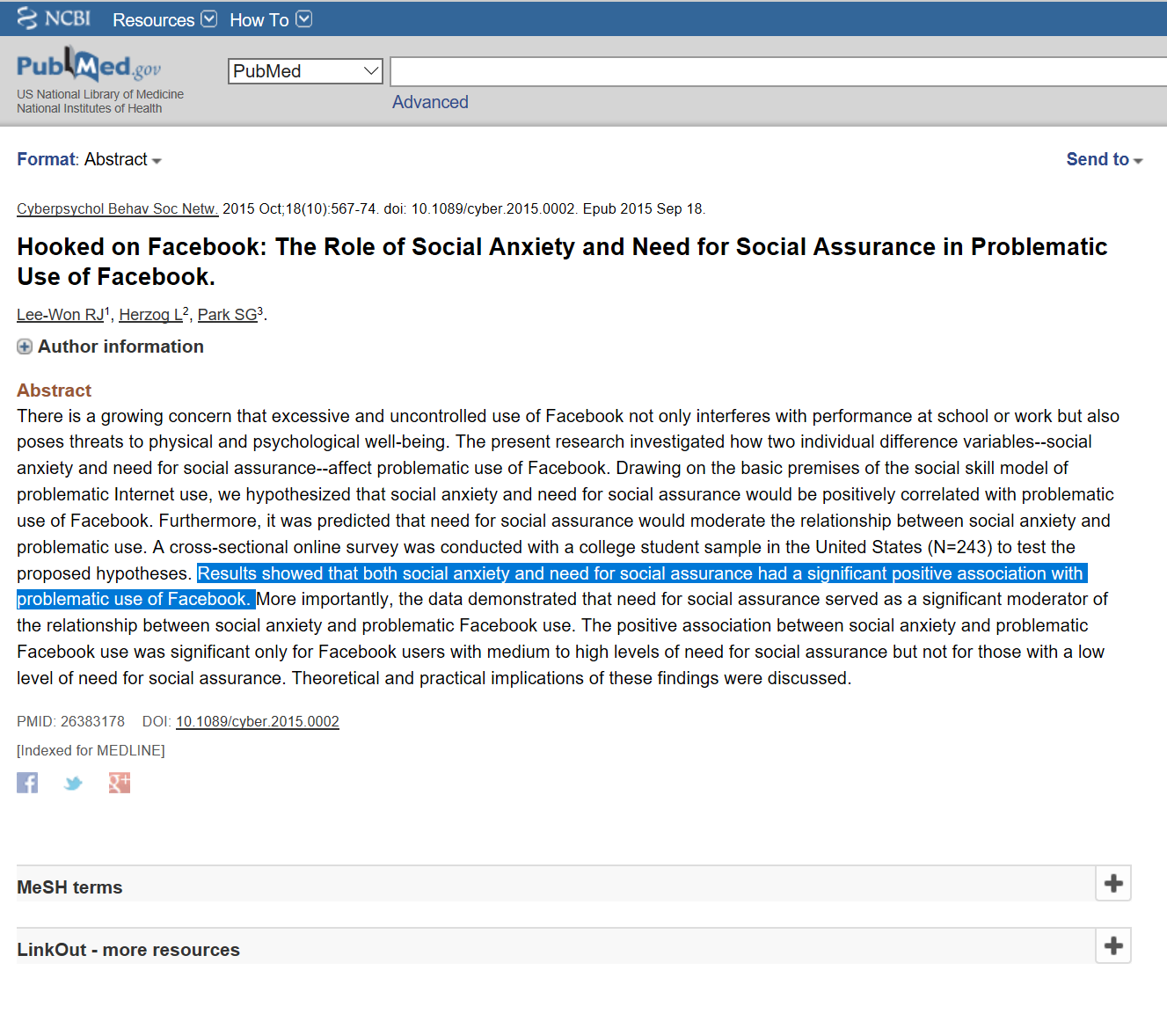
Guess what? Young Cgallo was technically right – at the time there wasn’t any scientific evidence. When I entered the search terms “Facebook, anxiety” into PubMed ( a database of life-science / biological articles), the earliest search result was from 2009, and the earliest might-be-relevant search result was dated 2013.

facebookanxiety1

facebookanxiety2
See?! I’m tellin the truf!

Why this delay? Because it took a while for older adults to realize how impactful Facebook was. Because research is slow. And so there was no evidence because, well, no one had looked for  it. But now there are articles galore on the relationship between Facebook use – and other forms of social media – in relation to anxiety.

facebookanxietyarticle
For example…

So Cgallo’s Mum in this imaginary situation was vindicated over time!

Takeaway #1: Sometimes someone can be technically correct that there is “no evidence” — but that’s because no one has published data on the topic at all!

Now, let’s imagine another scenario — what if there had been multiple studies of Facebook and anxiety, but most or all of the studies reported no significant correlation between Facebook use and anxiety. That is much more informative than there simply being no data at all… but it’s only moderately in favor of young Cgallo. When a study doesn’t find a relationship it could be because …

  • There is not a correlation between the variables of interest (in this case, Facebook use and anxiety)

OR…

  • Power issues: The study did not include enough participants to detect meaningful differences if they were there.
  • Operational-definition issues: The study defined anxiety in a funky way. One study might decide to look at Facebook use in relation to being diagnosed with an anxiety disorder by a therapist, another in relation to scoring high on a standardized anxiety scale, yet another in relation to self-reported feelings of stress.
  • Time-scale issues: The study could have looked at the effect of Facebook use over the course of a week and found no correlation to anxiety. That still doesn’t tell us much about the effect of Facebook use over several years.

Takeaway #2: Sometimes someone can be technically correct that there is “no evidence” — but that’s because all the studies conducted on the issue of interest had design issue(s). 

I remember the first time I really thought about this in graduate school, and it’s actually pretty frustrating. But there is almost always going to be another, usually different/better way a researcher could approach a research question. So often times, a lack of evidence means absolutely nothing meaningful IRL.

“What are you getting at here, Cgallo? Are you trying to suggest that we can never really say with confidence that two things are not related to each other??” demands you.

Mais non!” Cgallo sputters.

For one, if there are many good quality (e.g. large sample size, good operational definitions, relevant time scales) studies conducted on an issue and none of them find an association, that’s a pretty good clue that there may not actually be a relationship between Facebook use and anxiety, or whatever you’re interested in (autism and vaccine *cough cough*).

But let’s contrast all of this with the gold standard: evidence against!

Gold GIF - Find & Share on GIPHY

What do I mean? Well, many researchers are terrified of publishing mumbo jumbo, so they err on the side of caution and choose statistical tests that are more likely to give false negatives than false positives (I may go more into what this means in a future post, if it pleases the queen). As a result of this statistical conservatism (teehee), it’s quite difficult to get results that say “yes! Thing 1 is related to thing 2 in a meaningful way!” *SO* if you really want to argue that there’s no relationship between Facebook use and anxiety, find evidence against this statement. How? Well, what if there was an entire body of research pointing to Facebook use being linked to feelings of calm, tranquility, peace, stability, happiness, etc.? That is very different – and in my opinion, much more meaningful – than a simple absence of evidence.

Takeaway #3: The absence of evidence for something (e.g. Facebook use being anxiogenic) is not nearly as powerful as evidence for the opposite (e.g. Facebook use being anxiolytic).

Great! I think we all feel better now! Make sure you share this article on Facebook!

Justin Bieber Wink GIF - Find & Share on GIPHY

Think Like a Scientist: Don’t be a doof about “scientific proof”

“Scientifically proven”  is often thrown in as a final punch to convince you to buy something (“Scientifically proven to support liver health!” or take a certain political stance (“there is no scientific proof that teaching abstinence in public schools reduces teenage pregnancy.”). But regardless of my own susceptibility to marketing plots or personal political beliefs, this phrase often makes me cringe.

Cringe Smile GIF - Find & Share on GIPHY

Now, my goal here is *not* to convince you to doubt anyone and everyone who talks about scientific proof. There is, for example, strong scientific proof of gravity. So going too far in one direction – immediately rejecting a claim solely because someone assures you it has been scientifically proven – is just as stupid as immediately accepting a claim because someone assures you it has been scientifically proven.

So, how do you even begin to evaluate the “scientifically proven”claims?

Let’s start with a real life example of mine, with the nutrition company Neolife.

A few years back I had several friends who were bigtime crusaders for Neolife supplements.  “Cgallo you will be especially impressed by these supplements because they are backed by Science!” they would insist. In fact, the company tag-line is even “Based in nature | Backed in Science.” Being the curious and trusting person that I am, I went ahead and bought a 3 month prescription of their little super pack of wellness, which included all sorts of goodies like vitamins, minerals, fish oils, etc. At the end of the 3 months, my pee was very yellow and I was $100 poorer, but I wasn’t filled with such electrifying energy that I wanted to give up coffee or sprint up a mountain.* So of course after I spent my money and yellowed my pee, I decided to look into the original research that Neolife was so cocky about.

I found two original research articles. I think both of us only have the time and mental energy to tackle the first one. So, let’s chat about the article “Effects of a carotene-deficient diet on measures of blah blah blah” by Dixon and chums, published in 1994. The author affiliations were from respectable places like the University of California and the Center of Disease Control, so that seemed legit.

dixonetal
Always check author affiliations! It’s okay to be snobby about Neverheardof University. Of course, that doesn’t mean that any and all studies published by researchers at Harvard are flawless.. but it gives you an idea of the quality of research.


It was also published in Free Radical and Biology Medicine journal, which although I had never heard of, has a high impact factor,** so another check.

Then I began to read the methods.

Read Matthew Perry GIF - Find & Share on GIPHY

subjects

Umm.. 9 subjects? That is a very low number — especially for a study involving humans, who are chockfull of randomness and variation. Even lab rats have tons of variability in behavioral and physiological measures despite being in-bred and kept in extremely similar environments — so humans with all of our snowflake complexity are even worse!

*Anyway*

All 9 women were given a beta-carotene (which our bodies convert into Vitamin A) supplement for 4 days. These 4 days were considered baseline.

Then, for over 2 months the women were made to eat a diet very low in beta-carotene while taking nonsense (aka placebo) pills to trick the women into thinking they were taking beta-carotene.

For 28 days after that, all the women were given a supplement with a butt-load of beta-carotene AND for the very last 12 days, given six capsules of Neolife’s “carotenoid complex.” What is probably the most puzzling aspect of this study is that although they threw in Neolife products at the end of the study, they make no effort to distinguish the effects of mega-beta-carotene supplement alone from the effects of mega-beta-carotene supplement + Neolife carotenoid complex. So it is entirely unclear if any effects shown are due to the whopping serving of beta-carotene, the Neolife supplements, or a combination of both.

neolifetable

Confused Parks And Recreation GIF - Find & Share on GIPHY

Throughout all of this roller coaster of carotenes , they would take samples of the women’s blood to analyze the content for various markers of oxidation. Honestly, I’m a neuroscientist and unfamiliar with the exact techniques used in this study to measure different oxidants, so I’m not even going to touch that. But the great news is, neither you or I don’t have to know a thing about the techniques or measures of this study because the design and analyses tell us enough.

Let’s just review what we know so far, just by reading the methods —

  • This study was done on such a small number of women, even with an otherwise perfect study design all of the results should be taken with a grain of salt.
  • The researchers looked at the effects of supplementation for roughly 1 month. Neolife people want you to be popping their pills for life. That’s a pretty huge difference. If there’s some sort of long-term benefit or detriment to lifetime use, this study doesn’t even begin to address it.
  • As I harped on before — but is definitely worth saying again — this study made no effort to distinguish between the effects of a regular ol’ beta-carotene supplement and Neolife’s carotenoid complex.
  • Even if everything else about this study was perfect — including the techniques used to measure oxidation, that’s still just one measure. A very important general principle when evaluating “scientific proof” is what the researchers are using as their metric of effect. Often, extremely specific results like “beta-carotene supplementation reduced plasma TBARS and erythrocyte superoxide dismutase
    activity” — through a twisted game of telephone as non-scientist writers try to interpret and communicate the findings — eventually gets presented as “carrots can save your life!” But how many people know what plasma TBARS and erythrocyte superoxide dismutase activity actually is, and what low or high levels really mean? Certainly not I. So always look and see how researchers evaluated their end point, and try not to accept overly-simplistic explanations like “oxidation = bad. Supplement make oxidation low. Supplement = good.”
  • There was no “control group” that was not deprived of beta-carotene before given supplements, or any group that was deprived but then allowed to just start eating normally again without taking a booty load of carrot pills. Disrupting the body by force-depleting levels of a nutritive substance… and then showing your supplements can bring the levels back to normal … doesn’t tell us anything about whether they would work in populations with a normal range of beta-carotene levels, much less if it would even be healthy to increase levels too far above baseline! In almost every biological system, it’s about balance, not blasting the system with any one nutritive component. In fact, see this article written for lay audiences (original article here) indicating that too much beta-carotene can be risky biz.


Okay.. well that was cathartic for me, at least. I hope you all feel super smart and can now lay a scientific whoopin’ on anyone who tries to close the argument with “scientific proof.”

YOU’RE WELCOME, AMERICA!

American Flag America GIF - Find & Share on GIPHY

— EDITORIAL NOTES —

*I always want to saunter up a mountain. But sprinting is a different story.

Think Like a Scientist: Overcoming y axes deceptions

I have been through a lot of schooling. Some of it was a complete waste of time and utter nonsense. Some of it was useful. Thankfully, I am intellectually generous enough to share the highlights of my education so you all can be PhD-level thinkers without all the poverty-level stipends, rat bites, and bi-monthly existential crises.

I decided to write a series of short posts covering some of the most generally useful tools I learned to see through the b.s. when marketing companies, pop-science articles, politicians, and other ruffians present data in order to convince you of something.

This episode of Think Like a Scientist, let’s talk about y axes.

Okay, let’s set the scene. I’m the writer of Galloblog. I want you to read more Galloblog. In order to convince you, I throw this figure in your face –

galloblogfigure

Yowza! Pretty convincing, amiright?! Look how far apart those bars are! Reading Galloblog is equivalent to playing with puppies while eating peanut butter and listening to Tim Keller sermons!!

Or.. is it?!
galloblogfigure_yaxeshighlight.png
Let me give you a few things to consider when you look at that figure.

Note the y axes (in red) is zoomed in to show 0.7 to 0.8. The more zoomed in, the more dramatic any differences between bars will look.  Look at the figure below — far less impressive. Glancing at this figure, you may conclude that there are no differences at all, yes? But look! It’s the exact same data.

galloblogfigure2Now, “zooming” in on the differences between groups isn’t always a shady scientific practice, but when evaluating the quality / importance of the data presented it’s important to have an understanding of what the possible range of scores actually is.
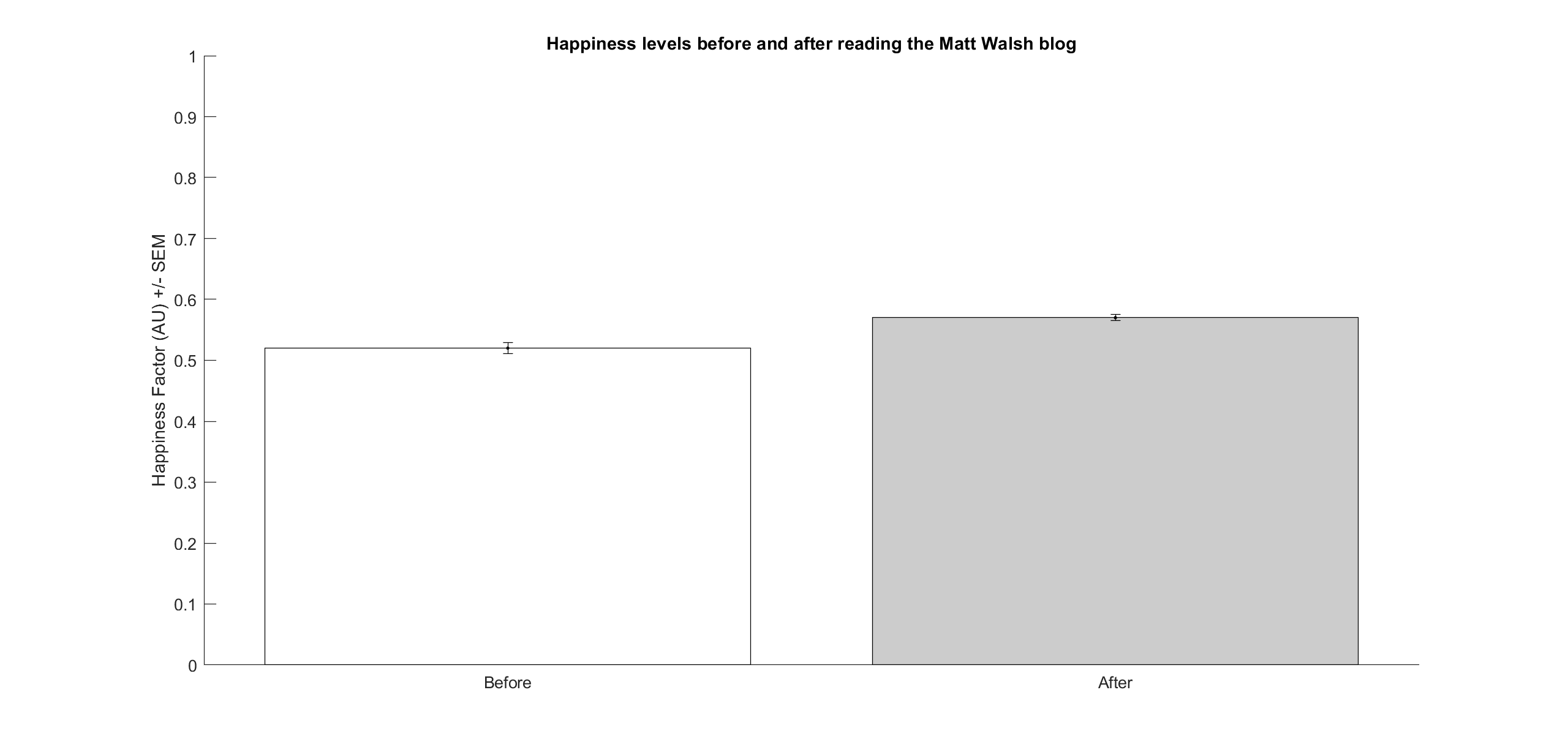
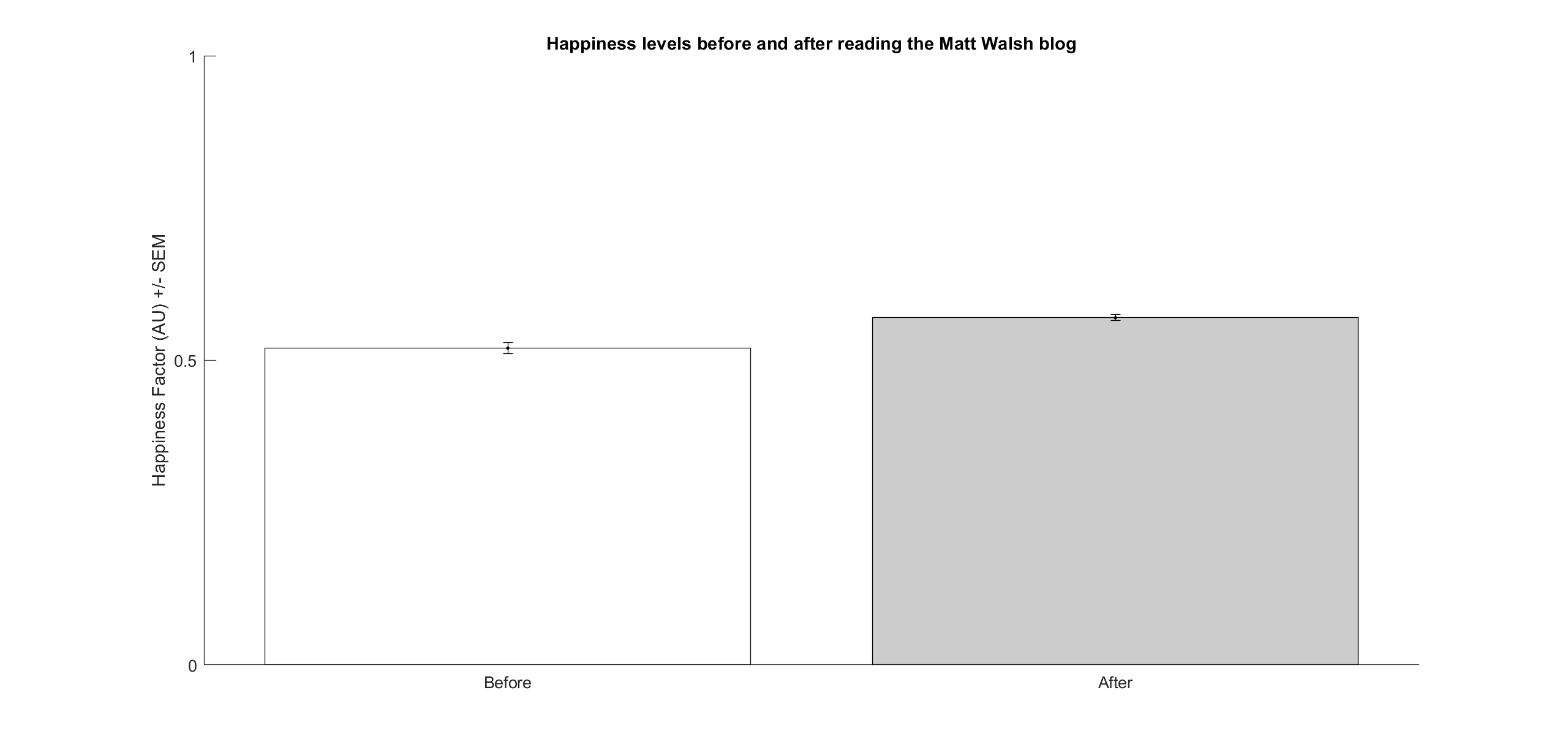

Ooo! I threw this in at the last minute for free! Something that drives me *insane* that I have seen far too many times in peer-reviewed scientific articles is showing two figures side by side – as a way to say “the difference between these two groups in this condition  (in this example, reading Galloblog) is real and we want you to be impressed by this, but we don’t want you to be impressed by the difference between these two groups in this other condition (in this example, reading Matt Walsh’s blog)” – but with different y axes!

galloblogfiguremattwalshfigure

If you just glanced at the figures above, you would think – “Yowza! Galloblog readers are so much happier than Matt Walsh blog readers!”

galloblogfigure2mattwalshfigure3

But if you made the Matt Walsh blog y axis scale the same “zoom” as the y axis in the Galloblog figure, they look pretty similar. The only real difference here is in the overall happiness level of Galloblog and Matt Walsh blog readers – not the effect of reading the blog. Surprise, surprise! 😉

Finally, let’s talk very briefly about the label of the y axis. The y label is “Happiness Factor (AU).” What is a “happiness factor” – is it a legit scale that many other researchers have used to evaluate happiness, or did Galloblog researchers pull it out of their bootays?

AU usually means arbitrary units, which means this scale isn’t linked to an observable measurement per se (e.g. “number of times smiled”) but is a relative scale. This doesn’t mean it’s not worth noting, but it does mean you should be asking “what is this happiness relative to?”

Okay — that is all the lecturing either of us could handle for right now. Stay tuned for more opportunities to become a sophisticated critic of all data!

xoxoxo,

cgallo, PhD

— EDITORIAL NOTES —

No Galloblog readers were harmed in the writing of this article. 

7 things (relative) poverty taught me were not essential


Many people don’t know this, but almost all PhDs get all their tuition waived and also receive a stipend. A stipend is – 

according to the googlez – 


according to C Galloz-

But who am I to bicker over definitions? The point is, I didn’t go into debt and I’m very happy that I was given enough money for my basic needs to be met, but trust me — it was basic. Now that I’m rolling in the fat post-doc g’s, I noticed that I’m starting to spend my money on all these little things. They’re not even “treat yoself” or splurge-y items, just kind of things that most adults would consider basic. But because I lived on the brink of poverty for 6+ years, I want to share which items and categories may seem like they are completely indispensable, but are actually quite possible to live without (and at least be decently content).

In no particular order *drum roll* 

  1. (Frequent) eating out / snack foods
    You don’t actually need pringles, or any other nonsense comfort food with zero nutritional value. Save yoself from a belly and wasted dollars!
  2. Alcohols 
    I enjoy cocktails just as much as the next person. *But* poverty is no time for boozin’! You can have fun without it! And if not, you may want to reconsider your friend choices! You will save yourself tens of dollars every week!
  3. New clothes 
    This gal probably just unloaded your entire months pay! Who wants credit card debt?! Not I! Heard of Plato’s closet?? It is your new best friend! Fancy hand-me-downs FTW! (*EXCEPTION*: unders! )
  4. Non-embarrassing car 
    Unless you’re also going to live in your car and shower in your lab (I considered this very seriously at one point!), it ain’t worth it. Go find a Craig’s list steal! I bought a car for $1,750 in grad school that ran for over 2 years with zero problems! (until the wheel fell of the axle, but that was my fault! #jumpedacurb)
  5. Cutting edge technology 
    Is it fun to facetime your friends? Of course! Is it necessary? Nope! I had a non-smart phone until.. 2014?? And even then, I didn’t have an iPhone until.. 2018! Guess what — I survived! I had friends! I survived in the modern age! You can, too – get a refurbished Samsung or a Motorolla E for like $60 and glory in your savings.


    6. Fancy hair dos 
    Does her hair look lit? Of course! Is it worth not being able to eat for 3 weeks? No! If you’re poor – and women, you’re going to need to sit down for this one – you do not have to dye your hair. The ombre, the balayage, the lowlights, whatever — they’re not necessary. You can have a cute cut for like…. $30? And get one 2x a year! I did that until 2018 and I mean.. maybe I didn’t look amazing at all times, but men still noticed me #obviously #truebeauty #lolz


    7. Trendiest of fitness routines 
    Tbh not even really sure what these women are doing. But in grad school, I 1) worked out at the student gym, for free and 2) ran, for free. And my bod was SLAMMIN’! Jk, but seriously – it was fine – in some ways, I was even more fit than I am now (cardio and I have had a falling out.. but we will probably reconcile before too long once I adequately snub her). So just because you’re broke doesn’t mean you are on an inevitable slide into obesity.


There you have it — if you’re looking to save some mula, or not sure how to survive the impoverished years of grad school – hopefully these tips will inspire you. I did it! It is possible! 

Do It Best Gif GIF - Find & Share on GIPHY

Like this post or DIE!!! 

Beware of inclement-weather friends

You’ve heard of fair-weather friends- those friends who are only with you in the good times. The friends who dip out when times get rough. They’re only by your side when the sun is shining brightly and you are paying for their Chipotle.

I must admit, howevers, that I haven’t had much experience with fair weather friends. When I’m feeling sadsies, especially about single or break-up angst, I’m surrounded by sympathetic friends who want to pat my head, take me out to coffee, and send me stockphotos of beach sunrises beset with inspirational Psalms in script writing. They are there with me in the storm. 

And all that is great. But recently I’ve noticed that many of these Sympathetic Sallies disappear when the sun starts peaking out again. If I’m doing well – especially relationship wise – I would estimate … hmmm … ~52% of these ladies go MIA. 

Perhaps I’m not being completely fair, but I have started to wonder if people who are unhappy actually relish hanging out with other people who are unhappy. But when their friend’s happiness increases, they begin to avoid them. 

They are inclement-weather friends. Only with you in the bad times. Dip out when times start looking up. They’re only by your side when the storm is raging and they’re paying for your Chipotle. 

Why are inclement weather friends a thing? I’m not 100% sure, but I think it may have something to do with the power dynamics of a relationship and pride. If someone is suffering, you can be their rock, comforter, life-line. It elevates you. When someone is rejoicing though, you lose power. You become more like a kindly Gma cheering on your friend. And maybe you start to resent them because you think if anyone deserves their life to pick up, it’s you– not this miserable little skank who could barely function without you a few months ago!  

Here’s to the ppls who can mourn and rejoice with their friends through all sorts of types of weather and nonsensical weather changes. I’ll call them.. Georgia weather friends. God bless you all 😀